
People often say "brain waves" like it's a magic word. Reality is more beautiful than magic: your cortex has an electrical pulse, and that pulse changes speed depending on what you're doing — thinking, resting, dreaming, sleeping. Nothing esoteric. It's been measurable for nearly a century.
Understanding these five regimes means understanding what Murmura sets out to do: not to force you, but to walk you from a lively level down to a calm one — the one where the body lets go and the imagination opens.
One brain, five speeds
Since the first electroencephalograms of the 1920s, we've been able to read the cortex's electrical activity as waves. These waves aren't a specific thought: they're the collective rhythm of millions of neurons firing together, faster or slower. We sort them into frequency bands, and each band matches a state you already know in your body.
The important — and reassuring — point: you move through these five regimes every day, naturally. No one installs an artificial state in you. All we do is help you slip toward the one you're after — and stay in it a little longer.
Five bands, five worlds
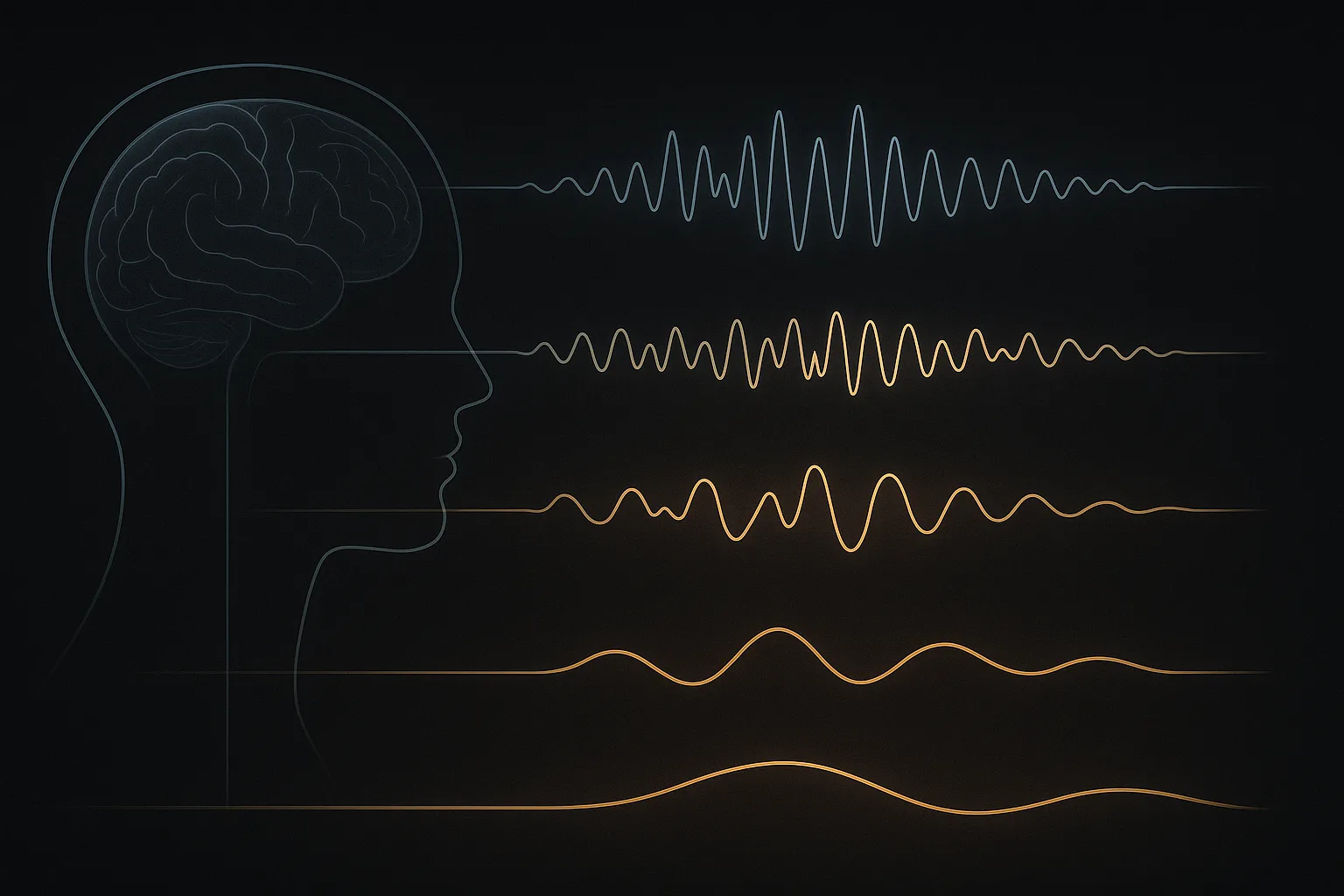
Here are the five levels, from the fastest regime (sharp wakefulness) to the slowest (deep sleep). Picture them as a staircase going down : at the top, the day's agitation; at the bottom, the night's repair.
The faster and tighter the wave, the more awake you are; the slower and wider, the further you descend toward sleep. In gold : the two levels Murmura sets out to open.
Standard classification in clinical electroencephalography (cortical frequency bands).
Alpha and theta — the fertile threshold
Murmura aims for neither the agitation of beta nor the unconsciousness of delta. It aims for the middle of the staircase : alpha (eight to twelve hertz) and theta (four to seven hertz).
Alpha is the moment you close your eyes and the agitation settles : calm wakefulness, daydreaming. Theta is one notch lower — the edge of sleep, where images rise on their own, where the body is loose but the mind stays clear. It's exactly the place where a suggestion passes without the critical mind blocking it, and where the imagination turns vivid.
That's why this threshold is fertile : not asleep, not agitated — open. The whole shape of a session is built to bring you there gently, then to hold you there a little longer than your natural drift toward sleep would.
The brain that tunes its rhythm
How could a sound help you change levels ? Through the frequency-following response : exposed to a steady, slow rhythm, the cortex would tend to tune its own rhythm to it — like a foot tapping the beat without your deciding to.
Murmura's wager : play a slow, real beat, set under headphones, to invite the mind to leave the day's fast waves and slide toward alpha, then theta. The exact mechanism of that beat — a third sound the ear never receives — has its own article in La Résonance.
Jirakittayakorn & Wongsawat, Frontiers in Neuroscience, 2017 — cortical synchronization measurable after several minutes.
What we will never promise you
Here's the honest part. That the brain has these five regimes is a solid, measurable, unquestioned fact. But the idea that a sound can move you deliberately from one level to another — and above all keep you there — remains debated in the literature.
Some studies report a measurable slide toward alpha or theta after a few minutes of listening ; others, better controlled, find no clear effect beyond simply sitting quietly with your eyes closed. Method matters enormously : duration, the frequency chosen, exactly what's being measured.
We will never sell you "change your brainwave in one click." What is certain is the experience : a real sonic frame, a voice, a ritual that genuinely helps the body settle — exactly as closing your eyes in quiet already makes you slide toward alpha. Sound is an honest ingredient of that slide, not a magic switch.
Literature review on binaural-beat entrainment — heterogeneous results (2019 and 2023 meta-analyses).
The states we aim for — calm wakefulness, the edge of sleep, the open imagination — are those of normal relaxation. Murmura is a relaxation and imagination experience. It comes in addition to, never in place of, a doctor. If you live with severe anxiety or sleep disorders, a professional remains the right door.