
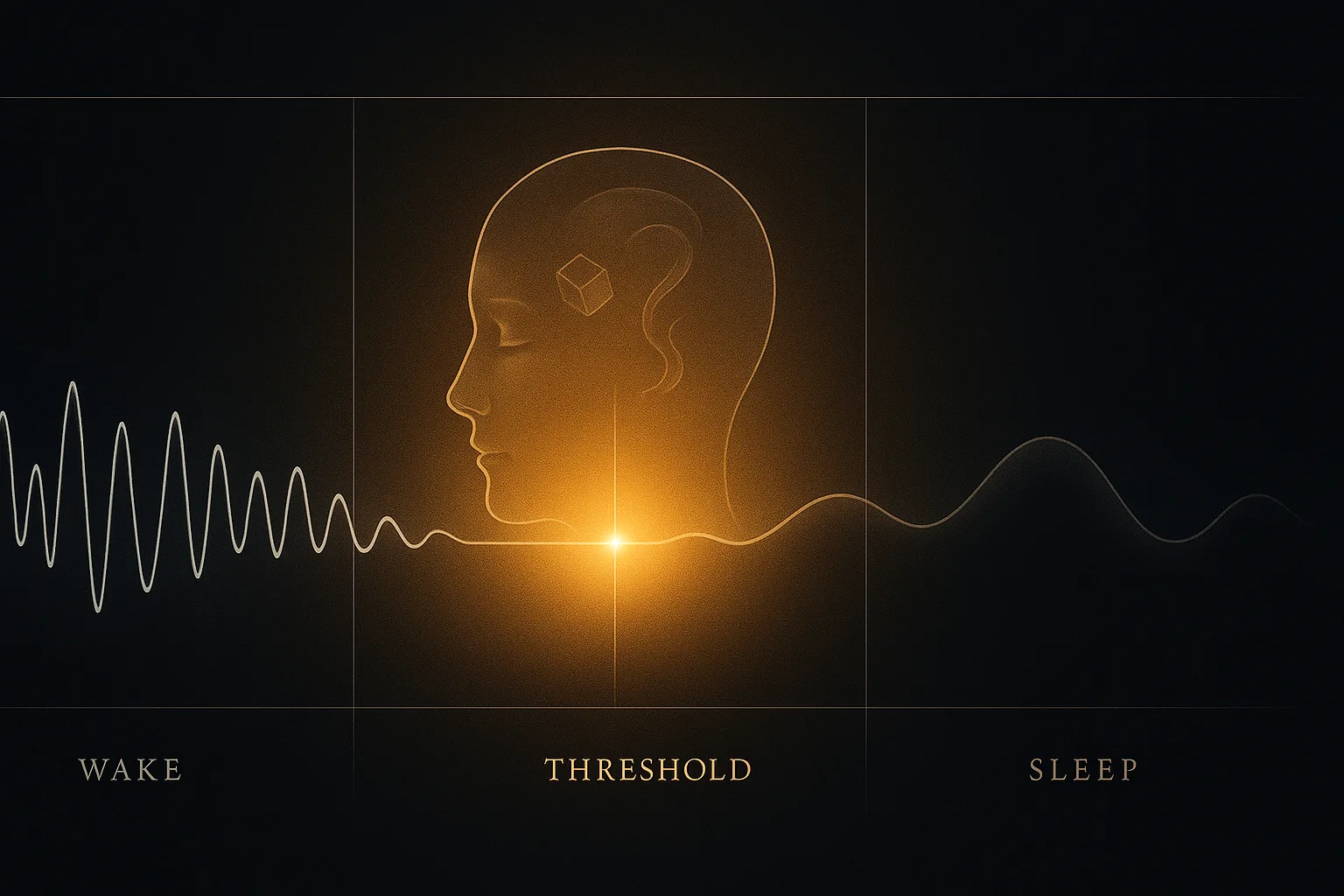
There's a moment, every night, that almost no one notices. The body grows heavy, thoughts stop holding hands, and without warning a face, a colour, a fragment of a scene appears behind your eyelids — then a jolt pulls you back, or sleep carries you off. That moment has a name : hypnagogia.
It's neither quite waking nor quite sleep. It's the threshold — and it's the territory Murmura sets out to open. Not to put you to sleep, but to hold you on the doorway a little longer than usual, your inner eyes wide open.
A door you cross without seeing it
Hypnagogia is the transition that leads from waking into sleep. It has a twin at waking up — hypnopompia — but it's the evening entrance we know best. Everyone crosses it, every day, as they fall asleep. Most of the time it lasts a few seconds and vanishes at once : you drift off and remember nothing.
And yet, when you do notice it, it's striking : verbal thought dissolves, logic loosens, and a spontaneous imagery rises — patterns, faces, snatches of sound, sometimes the sensation of falling. None of it is summoned on purpose. That's the nature of the threshold : the imagination starts working while conscious control falls asleep.
Between two shores
On the ladder of the brain's rhythms, hypnagogia isn't a fifth regime of its own : it's the passage between calm wakefulness (alpha) and first sleep (theta). It's precisely the fertile threshold our article on brain rhythms describes — the body loose, the mind still clear.
Hypnagogia isn't a destination but a passage : the golden door between calm waking and sleep. Murmura sets out to hold you there, without tipping you over.
The critic falls asleep before the imagination
Here's what makes this threshold so fertile : the conscious censor falls asleep first. The part of you that judges, sorts, corrects — the one that says "that's ridiculous" — steps back before the imagination goes out. During that brief gap, images pass through unfiltered.
That's where a suggestion slips in without hitting the critical mind, and where the imagination turns sharp.
That's why a session doesn't push you toward sleep : it eases you onto this threshold, then it holds you there. The voice becomes a thin thread, the sonic beat an anchor, and the inner space opens — recognizable, because you've already lived it a thousand times without naming it.
Dalí, the spoon and the key
Salvador Dalí would sit in an armchair, a heavy key held between thumb and forefinger, a metal plate set on the floor just below. He'd let himself slide toward sleep. At the precise instant he tipped over, his fingers loosened : the key fell, rang against the plate, and woke him — right when the visions of the threshold were at their most vivid. He called it sleep with a key.
He wasn't alone : Edison is said to have used the same trick with ball bearings in his hands. These artists and inventors had grasped intuitively what research later named : hypnagogia is a reservoir of free association, a creative workshop open for a few moments each night. Murmura doesn't make you drop the key : it replaces the ring with a voice that keeps you awake just enough.
Mavromatis, A. (1987). Hypnagogia: The Unique State of Consciousness Between Wakefulness and Sleep.
What we will never promise you
That hypnagogia exists, and that it's a distinct state rich in imagery, is solidly documented. What stays trickier is mastering it : holding it at will, prolonging it without tipping into sleep, drawing a precise vision from it on demand. That takes practice, and it works better for some people than for others.
These states are those of normal sleep, which your body produces every night. Murmura is a relaxation and imagination experience — it comes in addition to, never in place of, a doctor. If you live with sleep disorders or distress, a professional remains the right door.
Hypnagogia isn't a state to conquer : it's a door you already cross, every night, without seeing it. All Murmura does is teach you to recognize it — then hold you there a moment longer, so the imagination has time to show you something.