
Around "healing frequencies" there's an ocean of smoke and mirrors. We chose the opposite: to tell you only what's true, and explain it well enough that you can judge for yourself. This article is our open notebook.
You'll find three things a brochure never gives you: the precise organ that builds the beat, the exact thresholds where the phenomenon works and where it dies, and — the most honest part — where science still hesitates. Because a real reference doesn't skim the surface: it also names what we don't know.
A third sound the air doesn't carry
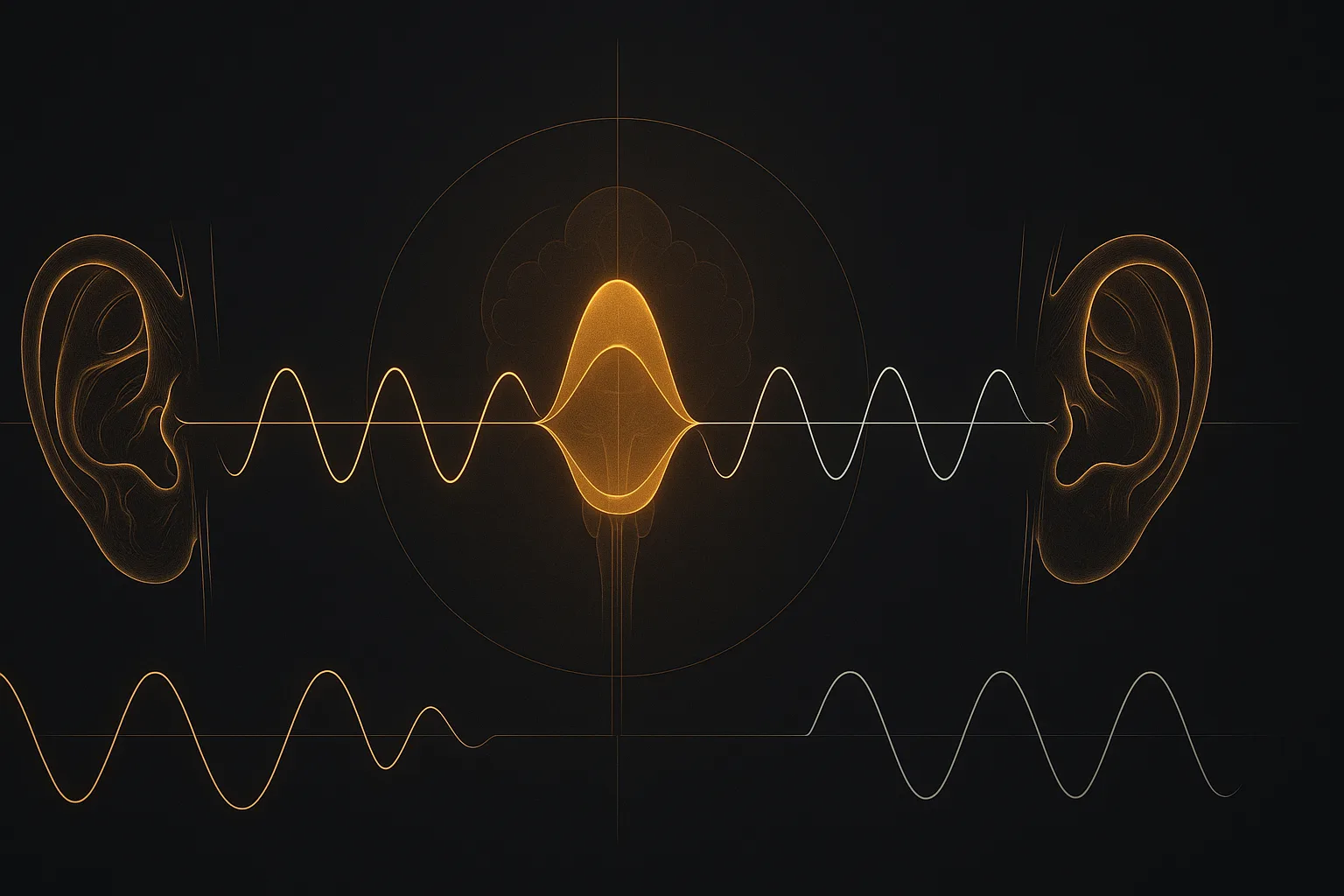
Send a pure tone of two hundred hertz into the left ear, and two hundred and ten hertz into the right. Neither ear receives a "ten hertz" — that frequency is present in neither sound. And yet you perceive a slow, steady pulse, ten beats per second. This phantom beat isn't in the air — it's computed inside your head.
The perception is born from the difference between the two frequencies, never present in the sound itself.
The Prussian physicist Heinrich Wilhelm Dove documented the phenomenon in 1839. It took the biophysicist Gerald Oster, in 1973 in Scientific American, to make clear why it's so peculiar: unlike an ordinary acoustic beat, the binaural beat never happens in the air. It requires each ear to receive its frequency separately — so headphones, without exception.
Dove, H. W. (1839) · Oster, G. "Auditory Beats in the Brain," Scientific American, 229(4), 1973.
Where the two ears meet
The beat is built in a precise place in the brainstem: the medial superior olive, a small nucleus of neurons. It's the very first floor of the brain where the information from both ears merges.
Its normal job has nothing mystical about it: it locates a sound in space, by comparing the tiny lag between a sound reaching the left ear and the right. The binaural beat hijacks this circuit — we feed it two slightly different frequencies, and the nucleus answers with an oscillation at their difference.
This is a crucial point for credibility: the binaural beat is not a "vibration of the universe." It's a measurable neurological artifact of a known circuit. That's why headphones are required, and why it only works at certain frequencies.
Wernick & Starr (1968), on the role of the medial superior olive in binaural processing.
Three conditions, precise
The phenomenon isn't magic: it's constrained. Naming those constraints precisely is the mark of someone who read the literature rather than the marketing.
Why these limits? Because the medial superior olive works on minuscule time lags between the two ears. Above roughly a thousand hertz of carrier, the wavelength becomes too short for that lag to stay interpretable: the brain then switches to another cue, and the beat goes out. Likewise, if the spread exceeds thirty-odd hertz, the ear separates cleanly — you hear two notes, not a pulse.
That's exactly why Murmura plays real beats under headphones, tuned inside those windows — never just an ambient recording. If the voice names a frequency, the audio engine truly plays it. Lying to the unconscious breaks everything.
Oster, G. (1973); synthesis of the psychoacoustic thresholds of the binaural beat.
The brain keeping time
The idea behind the relaxing use is the frequency-following response: exposed to a steady rhythm, the cortex would tend to tune its own rhythm to it — like a foot tapping the beat without anyone deciding to.
Murmura's wager: by playing a slow beat, to gently invite the mind out of the day's agitation (the fast beta waves, thirteen to thirty hertz) to slip toward waking calm (alpha, eight to twelve) then toward the threshold of dreaming (theta, four to seven) — where the body is loose but the imagination stays sharp.
Jirakittayakorn & Wongsawat, Frontiers in Neuroscience, 2017 — cortical synchronization measurable after several minutes.
The point the sellers never tell you
Here's the honest part. The existence of the binaural beat is beyond doubt — it's a reproducible perceptual fact since 1839. But its real effect on mental states — actually relaxing, sleeping better, focusing — remains debated in the literature.
Some studies report measurable effects on anxiety and relaxation; others, better controlled, find no clear difference from a plain placebo sound. A systematic review from 2023 concludes the results are heterogeneous: promising in places, but not yet a solid, universally reproduced effect. Method matters enormously — listening duration, chosen frequency, what you measure.
We'll never sell you the binaural beat as a medicine. What is certain is the experience: a real sonic setting, a voice, a ritual that helps the body settle. The beat is an honest ingredient of that experience, tuned to real frequencies — not a promise of healing. That's sturdier, and truer, than a miracle in a bottle.
Garcia-Argibay et al., meta-analysis on binaural beats (Psychological Research, 2019); systematic review 2023 — heterogeneous results.
The states we aim for — calm, the threshold of sleep, an open imagination — are those of ordinary relaxation. Murmura is a relaxation and imagination experience. It comes in addition to, never in place of, a doctor. If you live with severe anxiety or a sleep disorder, a professional remains the right door.